
Occupy Wall Street was a protest movement that began on September 17, 2011, in Zuccotti Park, located in New York City’s Wall Street financial district, against economic inequality. The Canadian anti-consumerist and pro-environment group/magazine Adbusters initiated the call for a protest. It was initially caused by wealth inequality, political corruption, and corporate influence of government. The perceived lack of “real democracy” spread progressively around the world to start new forms of democracy. This movement sparked protests in countries like France, Germany, and Great Britain.
This anti-capitalist movement is remarkable for the prominent role social media played in its media framing, and in particular Twitter, which played in facilitating communication among its participants. Twitter represented a valuable resource for supporting the movement’s political and social objectives by functioning as a high-visibility forum that the audience could interact and share information in real time. This enabled Occupy users to leverage Twitter’s media framing as a platform for communicate to spread time-sensitive information about protest and police action at the local level.
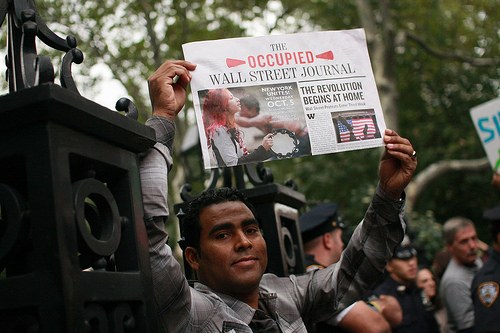
However, there was criticism of how the Occupy movement was framed by the media. Newspapers and television networks were rebuked by media critics for treating the movement as if it were a political campaign or a sideshow — by many liberals for treating the protesters dismissively, and by conservatives, conversely, for taking the protesters too seriously. At first, the left complained that news organizations had ignored the movement altogether. There were also reports of journalists experienced restraints from police who were trying to cover the social movement so they weren’t quite sure how to characterize what they saw. This led to bias coverage of the movement from FoxNews and MSNBC. Journalists employed by these organizations were getting fired for participating in the protest. Overall, it did draw attention by the way media framed it. Coverage eventually spiked with many mediums covering the social movement. It hit a low again, until the situation where police arrested 700 demonstrators for attempting to march across the Brooklyn Bridge.
Links to sources:
- Conover, Michael D., et al. “The Digital Evolution of Occupy Wall Street.” PLoS ONE, vol. 8, no. 5, 29 May 2013, p. e64679, journals.plos.org/plosone/article?id=10.1371/journal.pone.0064679, 10.1371/journal.pone.0064679. Accessed 1 Dec. 2019
- Horn, Heather. “None.” The Atlantic, The Atlantic, 14 Oct. 2011, http://www.theatlantic.com/international/archive/2011/10/how-world-media-is-covering-occupy-wall-street/246677/. Accessed 1 Dec. 2019.
- “Occupy Wall Street Puts the Coverage in the Spotlight.” The New York Times, 21 Nov. 2011, http://www.nytimes.com/2011/11/21/business/media/occupy-wall-street-puts-the-coverage-in-the-spotlight.html. Accessed 1 Dec. 2019.
- “Tracking the Medias Eye on Occupy Wall Street.” Npr.Org, 2019, http://www.npr.org/2011/10/13/141320149/tracking-the-medias-eye-on-occupy-wall-street. Accessed 1 Dec. 2019.
 social media social mvmnt