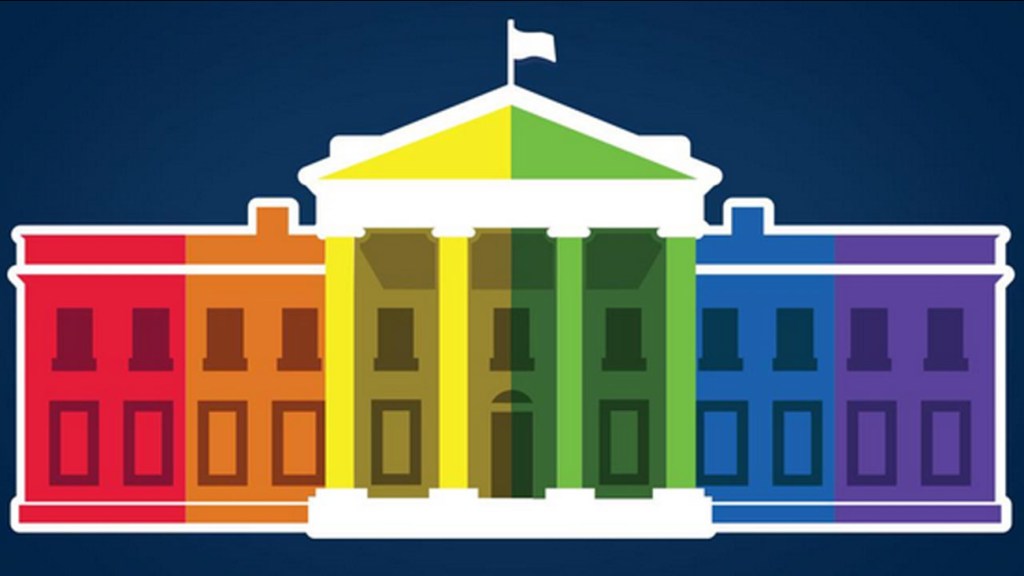
The #Lovewins was a movement to commemorate the victorious Supreme Court ruling of marriage equality nationwide in the U.S. It was used to express the acceptance of unity of love between any two people regardless of sexuality or gender. On the morning of Friday, June 26, 2015, the U. S. Supreme Court ruled in the case of Obergefell v. Hodges, commonly known as the marriage equality ruling. Within the minutes of the announcement, social media exploded with posts about the news. Participants in the online celebration rallied around the hashtag #LoveWins, with Twitter posts using the hashtag cresting at 5,187,809 when the day was done. The most shared tweet was from former President Barack Obama stating: “Today is a big step in our march toward equality. Gay and lesbian couple now have the right to marry, just like anyone else. #LoveWins.” Media framing pushed this judiciary decision into a mega-trending hastag across all mediums. From there the celebratory hashtag spanned from celebrities, companies, amusment parks like Disneyland, and cities standing together in solidarity of the movement.
The marriage equality movement started before the judiciary decision. In 2010, the organization ‘Freedom to Marry’’s digital team has been responsible for galvanizing the marriage equality message nationwide—that the story of marriage equality centers on love and family, not politics—through social media and other digital storytelling. They worked online and offline to redefine the misconceived partisan issue by place a media-framed emphasis on family by showcasing the love and commitment of real couples, in a way that humanized the issue while also making it inclusive. Unlike other organizations, the team showed the “unexpected couple” that wasn’t orginally being support in these conversations, like Jessica and Chi, an African American couple from the south or Master Sergeant T. Ashley Metcalf, who served in the U.S Air Force. In doing so, Freedom Marry hoisted themselves up to become the central campaign that wasn’t only devoted to win but was truly an authentic national campaign.

However, there was a study that investigated substantive differences in how media framed the Supreme Court ruling legalizing same-sex marriage in different politically-opinionated states. This was observed through representation of newspaper front page coverage, with a different emphasis on the coverage between “red” and “blue” states. Framing decisions expressed through headline word choice and space allocation were analyzed as examples of variation within the media agenda. The findings suggest the media agenda is in fact significantly impacted at the local level. Perhaps it was used to sway people with various mindsets to agree on something that has been a huge humanities civil rights issues.
Links to souces:
- “Behind The Hashtag: #LoveWins.” Hashtags Unplugged, 2016, series.hashtagsunplugged.com/lovewins.
- Stewart, Dominique. “#LOVEWINS: How a Social Media Campaign Promoting Marriage Equality Swept the Nation.” Brooklyn Magazine, Brooklyn Magazine, 14 Sept. 2015, http://www.bkmag.com/2015/09/14/lovewins-how-a-social-media-campaign-promoting-marriage-equality-swept-the-nation/. Accessed 1 Dec. 2019.
- “Newspaper and Online News 2016 Abstracts.” AEJMC, 9 June 2016, http://www.aejmc.org/home/2016/06/news-2016-abstracts/. Accessed 11 Dec. 2019.
 social media social mvmnt